16 September 2026 | Wednesday | Interaction
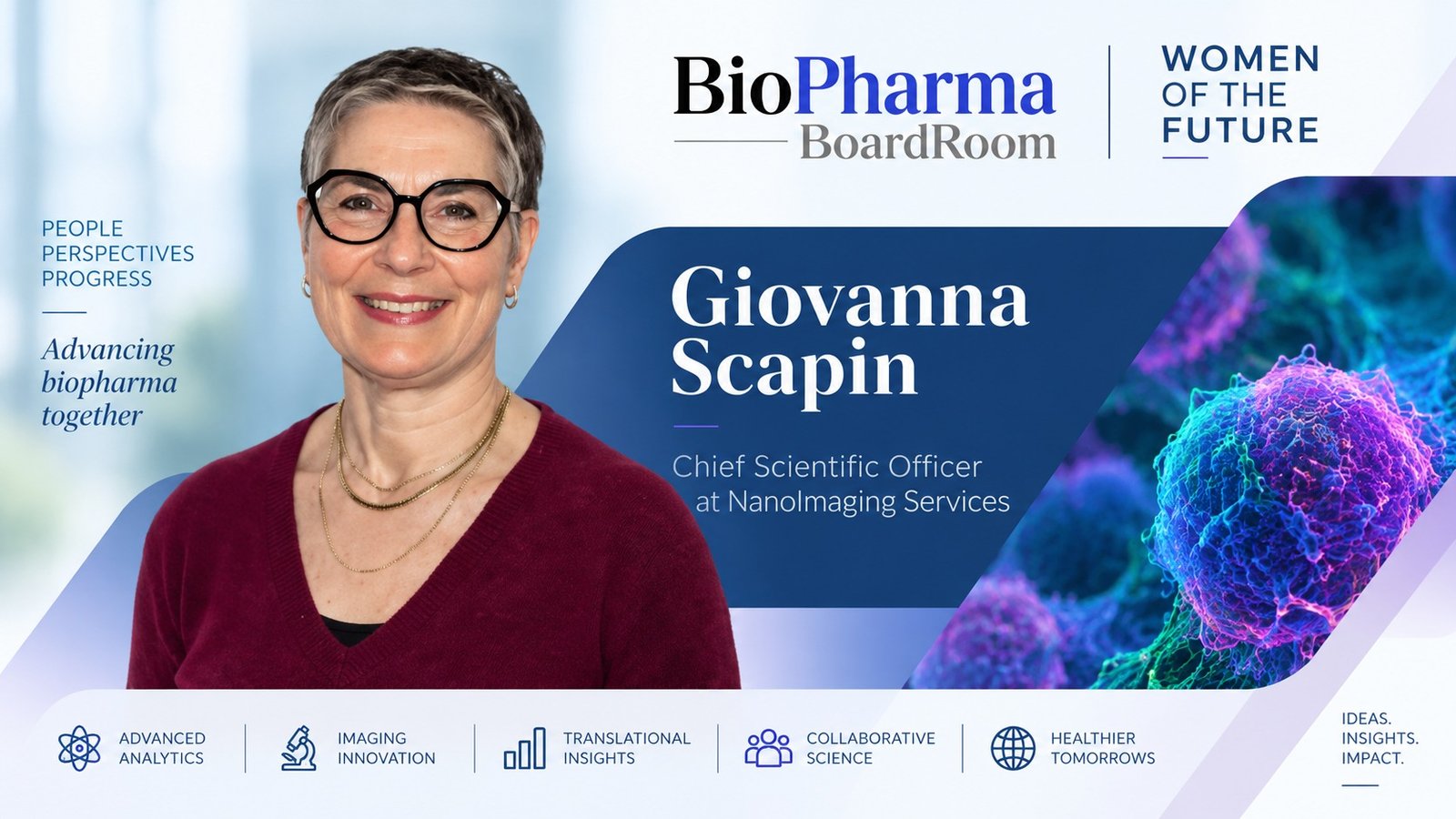
As biologics and novel modalities become increasingly sophisticated, understanding molecular structure under controlled conditions tells only part of the story. The emerging analytical challenge is to connect molecular structure and cellular phenotype with what therapies actually do within intact tissue, where distribution, concentration and biological context can influence therapeutic performance.
In this Women of the Future conversation with BioPharma BoardRoom, Giovanna Scapin, Chief Scientific Officer at NanoImaging Services, examines the potential of advanced imaging to close the gap between in vitro characterisation and in vivo understanding. She also highlights why deeper collaboration between academia, biopharma and specialist technology providers will be essential to turn disruptive scientific ideas and increasingly powerful analytical technologies into practical advances for drug development.
As biologics and novel modalities become more complex, where do you see the greatest opportunities for analytical innovation?
Analytical tools have grown remarkably sophisticated, and they have taught us a great deal about the biology, chemistry and activity of therapeutic agents: what they look like, how they engage their targets, how stable they are over time and how best to formulate and deliver them.
But nearly all of these methods are in vitro, or at most cell-based. They can tell us what a molecule can do under controlled conditions, but not what it actually does inside a living organism. For biologics and novel modalities, where distribution, local concentration and tissue context often determine whether a therapy works, that gap matters more than it used to.
The greatest opportunity for analytical innovation, in my view, lies in bridging that gap: connecting molecular structure and cellular phenotype to biological events in intact tissue. High-resolution tissue imaging, correlative imaging, volume electron microscopy and in situ structural biology are the techniques most likely to get us there. Each addresses a different part of the problem, and combining them is where the real difficulty, and the real potential, sits.
Getting there will require advances not only in instrumentation but in sample preparation, throughput and the computational tools needed to make sense of very large, very heterogeneous datasets. That is a significant challenge, but it is also the most direct route to understanding how these complex therapies actually work in vivo.
How are advances in imaging and analytical technologies changing the way biopharma companies characterise and develop complex biologic modalities?
Advances in scientific understanding rarely come from a single source. Academia, technology providers and biopharma each contribute something the others cannot, and real progress depends on all three.
Academia provides an environment where novel, disruptive ideas can emerge. Its strength lies in the diversity of the people who teach, study and conduct research, as well as the freedom to pursue questions whose value may not be immediately apparent and follow unexpected results beyond predefined milestones. That freedom is what allows genuinely new ideas to take root.
Biopharma takes those ideas forward. Its infrastructure, development experience and capital can turn an early observation into a deep understanding of the underlying biology and chemistry, and eventually into a medicine. This is work that demands scale and sustained investment few academic labs can command.
Technology providers can accelerate progress across both academia and biopharma by providing specialized expertise and instrumentation. They can also take on demanding analytical work and deliver reliable results, allowing academic groups to pursue research that may otherwise be difficult to access and giving biopharma teams greater confidence in their development decisions. In this way, advanced analytical techniques become more accessible to both.
The relationship between academia, biopharma and technology providers also works in multiple directions. Questions that emerge during development can inform further academic research, while advances in instrumentation can create new opportunities for scientific investigation. Each plays a distinct role in advancing scientific knowledge and translating it into practical applications, making continued collaboration across all three important for innovation.




© 2026 Biopharma Boardroom. All Rights Reserved.