03 August 2026 | Monday | News
In biopharma, critical decisions are often shaped by more than clinical data, regulatory insights, or operational metrics. The most important signals may emerge through conversations — in the hesitation before an answer, the concern left unspoken, or the shift in confidence around a key decision.
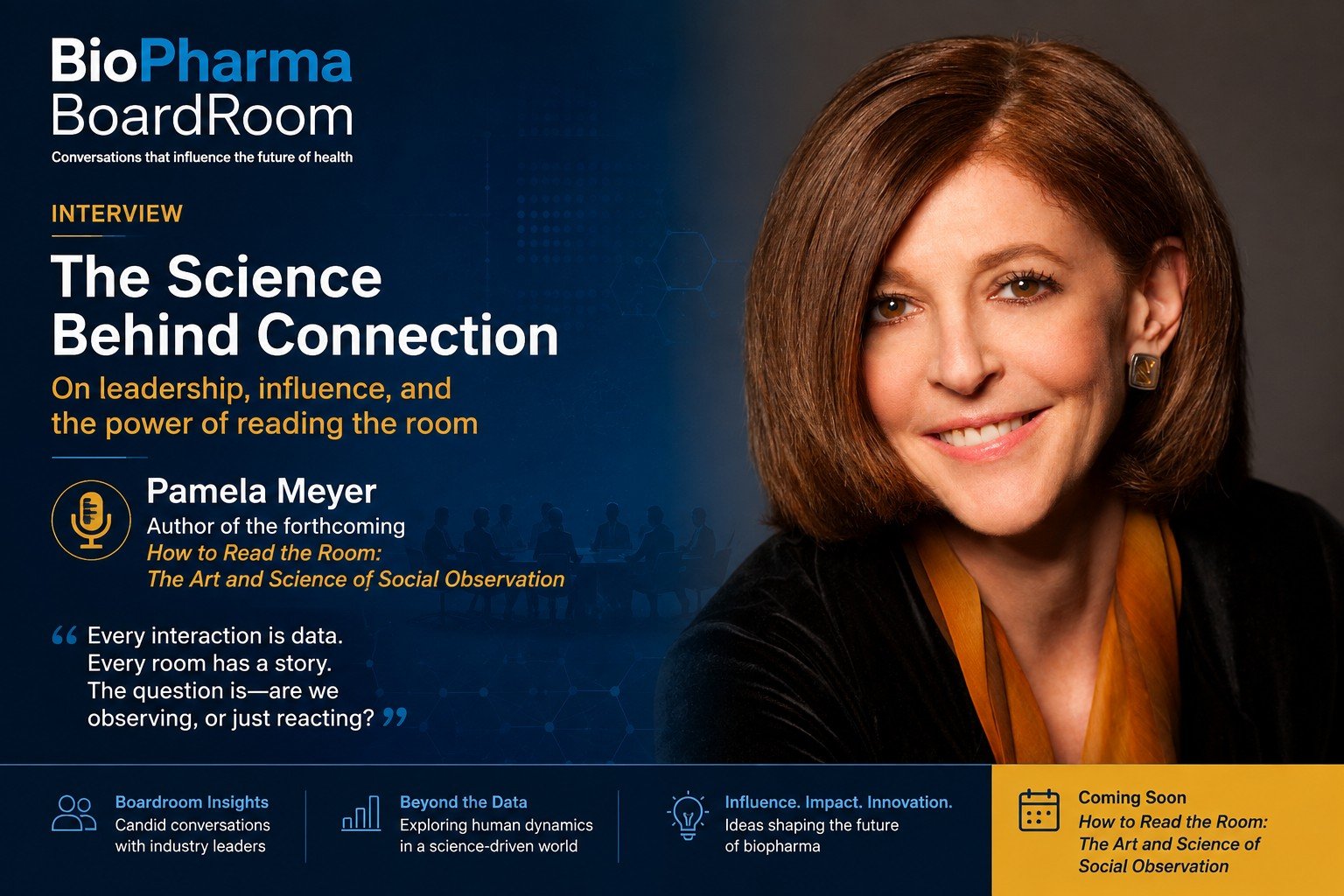
In this interview with BioPharma BoardRoom, Pamela Meyer, author of the forthcoming How to Read the Room: The Art and Science of Social Observation, discusses why social observation is becoming an essential leadership capability in life sciences. She shares how executives can recognise hidden risks, encourage candid cross-functional discussions, ask better questions, and build cultures where early warnings are valued as a strength rather than a setback.
Why is social observation becoming an increasingly important leadership skill for biopharma executives operating in high-stakes environments?
Biopharma executives have access to extraordinary amounts of information. They can review clinical data, enrollment projections, manufacturing metrics, safety reports, regulatory correspondence, market forecasts, and increasingly sophisticated AI analysis.
Yet some of the most consequential information never enters the formal recor
It appears in the meeting before it reaches the slide. A scientist qualifies a conclusion that the presentation states confidently. A manufacturing concern is recast as a scheduling issue. Commercial expectations begin to shape the interpretation of clinical evidence. Someone prepares to raise a difficult point, sees where the senior leader is leaning, and decides against it.
Social observation is the ability to notice how information changes as people exchange it. It requires leaders to listen for shifts in language, track how status affects participation, and recognize when the confidence displayed in the room exceeds the confidence held by the people in it.
That skill is especially important in biopharma because knowledge is distributed across highly specialized functions. The scientist who understands the assay may not understand the scale-up risk. Regulatory may see implications that clinical development has missed. Quality may recognize that an aggressive timetable leaves too little room to investigate a deviation. Commercial may identify an access problem that changes the value of the entire development strategy.
No executive can master every discipline. Sound leadership therefore depends on whether people bring what they know into the discussion, and whether decision-makers can tell when they are holding something back.
The stakes make that harder. A concern may threaten years of work, a promising asset, an upcoming filing, a manufacturing commitment, or expectations already communicated to investors. The more important the program becomes, the greater the pressure to interpret uncertainty favorably.
A skilled room reader does not treat every pause, hedge, or change in tone as proof of trouble. The leader compares the behavior with the person’s usual style, looks for several changes occurring together, and asks a precise follow-up question.
In that sense, social observation is a form of risk detection. It helps executives identify the point at which scientific uncertainty begins to harden into organizational confidence.
What behavioral signals or communication patterns most often indicate that concerns, disagreements, or risks are not being fully expressed during leadership or cross-functional discussions?
The clearest signals often appear in the language people choose.
Qualifying Language: Phrases such as “probably manageable,” “directionally positive,” “within expectations,” “nothing we have not seen before,” or “no obvious showstoppers” deserve attention. Each may be accurate. Each can also provide reassurance without making a claim that can be tested.
The most useful response is to ask for the missing specifics. What would managing the issue require? Which expectation does it fall within? What evidence would make it a showstopper? Who has examined that conclusion independently?
Passive language- can obscure responsibility. “It was determined that the deviation was immaterial” removes the people who made the determination. “Some concerns were raised” says nothing about who raised them, how strongly they felt, or whether the concerns were resolved.
Leaders should restore the missing subjects and verbs. Who determined this? On what basis? What exactly did the dissenting person believe? What happened after the concern was raised?
Deflection: Another signal is the answer that does not quite match the question. Ask whether a process will scale and receive an account of how hard the team has worked. Ask whether an agency is likely to accept an endpoint and hear a detailed history of previous interactions. Ask whether a forecast rests on an untested assumption and receive a description of the market opportunity.
The answer may contain relevant information. The gap between the question and the response often points to the area that deserves another look.
Executives should also notice which issues are repeatedly deferred. “Let’s take that offline” can keep a meeting moving. It can also remove an uncomfortable concern from the room where the decision is being made. If questions about safety, quality, manufacturability, or regulatory exposure are repeatedly postponed while investment and timing remain central, the discussion may be narrowing too soon.
Fast consensus deserves examination as well. It may reflect thorough preparation. It may also mean that dissent occurred before the meeting, that important functions were excluded, or that participants believe the decision has already been made.
Behavior gives the language context. Does a technical expert look toward the program leader before answering? Does a junior scientist stop speaking when a senior colleague begins summarizing? Does the room become animated when discussing opportunity and restrained when the conversation turns to execution risk?
No single behavior settles the matter. The pattern tells the leader where to ask again.
How can leaders create an environment that encourages more candid conversations while maintaining trust, psychological safety, and accountability across scientific and business teams?
Leaders create candor through their response to inconvenient information.
Many executives tell their teams, “Bring me bad news early.” Employees then watch what happens to the first person who does. If the leader becomes defensive, questions the messenger’s competence, or immediately searches for a more favorable interpretation, the team learns that early warning carries a personal cost.
The next concern will arrive later and in softer language.
Psychological safety allows people to question an assumption, report a mistake, or challenge a senior colleague without fear of humiliation or retaliation. It does not excuse vague claims or poor preparation. A person raising a concern remains responsible for explaining what was observed, why it matters, and what evidence supports it.
Leaders can protect both safety and accountability by responding with disciplined curiosity:
This response gives the organization a process for testing the concern without accepting or dismissing it prematurely.
The order of the discussion also matters. Senior leaders should often speak later, especially when the decision depends on independent expert judgment. Once a chief executive, chief medical officer, or program leader states a preference, subsequent contributions can become reactions to authority.
Functions should also be asked to state their views separately before the group begins negotiating a common recommendation. Clinical, biostatistics, regulatory, quality, manufacturing, medical affairs, and commercial teams see different parts of the risk. Their initial judgments should be heard or documented before the language is blended into a single organizational position.
Leaders then need to close the loop. When someone raises a concern, record it, assign responsibility, explain what will be examined, and return with the outcome. A risk that disappears into the meeting notes teaches people that speaking up produces discussion but little action.
Trust does not require every concern to prevail. People need confidence that the issue received a fair examination and that challenging a favored course will not quietly damage their standing.
Candor becomes sustainable when leaders treat accurate early warning as professional competence. In biopharma, the person who identifies the problem before the filing, transfer, inspection, or launch has protected the organization, even when the discovery creates cost or delay.
Can you share practical techniques that executives can use to improve decision-making by asking better follow-up questions and recognizing hidden dynamics during meetings?
Executives often end presentations with broad questions: “Any concerns?” “Are we comfortable?” “Does everyone agree?”
These questions rarely produce useful information. By the time they are asked, the room may appear aligned. Speaking honestly then requires one person to challenge the apparent position of the group.
Specific questions at this point in a meeting make dissent easier.
Ask, “What has changed since our last review that increased or decreased your confidence?” This separates new evidence from a conclusion that may have hardened months earlier. It also makes declining confidence a legitimate answer rather than an admission of failure.
Ask, “What finding would cause us to reconsider this recommendation?” Teams can become highly skilled at collecting evidence for the path they already favor. This question tests whether the conclusion remains open to revision.
Another useful question is, “Which problem are we assuming another function will solve later?” Early decisions can create downstream burdens for manufacturing, quality, regulatory, supply, or commercialization. A plan may appear efficient because part of its cost has been pushed beyond the current meeting.
Then ask a second question. The first answer is often prepared and categorical. A follow-up gets closer to the actual concern: “What makes you hesitate?” “What are we missing?” “What would you want to know before putting your name on this?”
Don’t ask “why” Executives should be very careful with questions beginning with “why.” They can sound accusatory and push people to defend a decision. “What led you in that direction?” or “Which factors hold the most weight?” invite explanation without creating the same pressure.
Leaders should also search for the missing or absent voice. Who is closest to the work and has not spoken? Which function will inherit the consequences of the decision? Who disagreed during preparation? Whose judgment changed before the meeting?
The behavior in the room is part of the evidence. Notice who is allowed to finish a thought, whose concerns are challenged immediately, and whose claims pass without scrutiny. Watch whether favorable and unfavorable evidence receive equal attention. Pay close attention to the moment when the group stops evaluating a recommendation and begins defending it.
Before closing, ask, “What has received too little attention because it complicates this recommendation?”
Then wait.
Leaders often destroy the value of a strong question by answering it themselves after two seconds. Silence gives the person with the missing information a chance to speak.
Are there lessons from behavioral science that biopharma organizations can apply to strengthen collaboration across R&D, regulatory, manufacturing, and commercial functions?
One important lesson concerns shared information. Groups tend to discuss what several members already know. Information held by one specialist is less likely to shape the conversation, even when it is more valuable.
This creates a serious problem in biopharma. Cross-functional meetings exist because each discipline holds knowledge the others do not. If every function simply repeats the central program narrative, the meeting creates the appearance of integration without gaining the benefit of distributed expertise.
Leaders can counter this tendency before the meeting begins. Ask each function to identify one fact others are unlikely to know, one assumption that deserves testing, and one downstream consequence missing from the current plan. This brings distinctive knowledge into the discussion before the group converges around a single account.
A second lesson involves the reluctance to carry bad news upward. People often delay, soften, or qualify information that may disappoint a senior figure or damage an important initiative. In biopharma, the professional and emotional investment in a program can be immense. Teams may have spent years working toward a milestone. An unwelcome result can threaten the project, a person’s status, and long-standing relationships.
Organizations can reduce that pressure by separating discovery from blame. The first conversation should establish what happened and what it means. Questions of accountability can follow. When leaders collapse both conversations into one, people become more cautious about reporting early signs.
Hierarchy creates another problem. The most senior person’s view can shape what others notice, remember, and feel comfortable saying. Collecting independent assessments before open discussion helps preserve expert judgment. So does asking the people closest to the work to speak before senior executives comment.
Collaboration improves when people are rewarded for improving the enterprise decision, including problems they identify outside their immediate remit.
Looking ahead, how do you see the role of social observation evolving as AI, hybrid workplaces, and increasingly global teams reshape leadership and communication in the life sciences industry?
AI can generate polished conclusions faster than leaders can validate them. It can synthesize research, model scenarios, and summarize regulatory correspondence. It can also make weak reasoning sound authoritative.
Leaders will need to ask who selected the inputs, which assumptions shaped the analysis, what evidence was excluded, and who stands behind the recommendation. AI is best suited to data-intensive work. Complex judgments about credibility, disagreement, and risk still require human scrutiny.
Social observation will become more important when a group begins deferring to an AI-generated conclusion that no one can fully explain. Fluency with polished language will become commonplace but should never substitute for understanding.
Hybrid work presents a different challenge. Video meetings limit access to side conversations and full-body behavior. Participants may appear attentive while disengaging. Leaders will need to compare what happens in the formal meeting with the written follow-up or a smaller technical discussion. Virtual reviews may work well for structured decisions. Difficult disagreement often requires much richer in person interaction.
As biopharma becomes more technologically advanced, leadership will still depend on determining whether the people closest to the work believe the conclusion being presented. The concern that protects a patient or a program may first appear as a qualified answer or a sentence someone chooses not to finish. These are what we call messy signals, and AI can’t yet capture them and assign accurate labels to them. Silence can mean caution, it can mean alignment, it can mean anger, or it can mean deference.
When in doubt, pause, read the room and don’t speak until you have something to say that connects directly to the conversation. It will transform your professional life.
Pamela Meyer is the author of the forthcoming book How to Read the Room, available for pre-
order now. A leading speaker and expert on deception detection, she is CEO of a
Washington, D.C.-based firm that trains executives and institutional leaders in information
elicitation and insider threat mitigation. Her Masterclass offers continuing education credits for a variety of professionals.




© 2026 Biopharma Boardroom. All Rights Reserved.