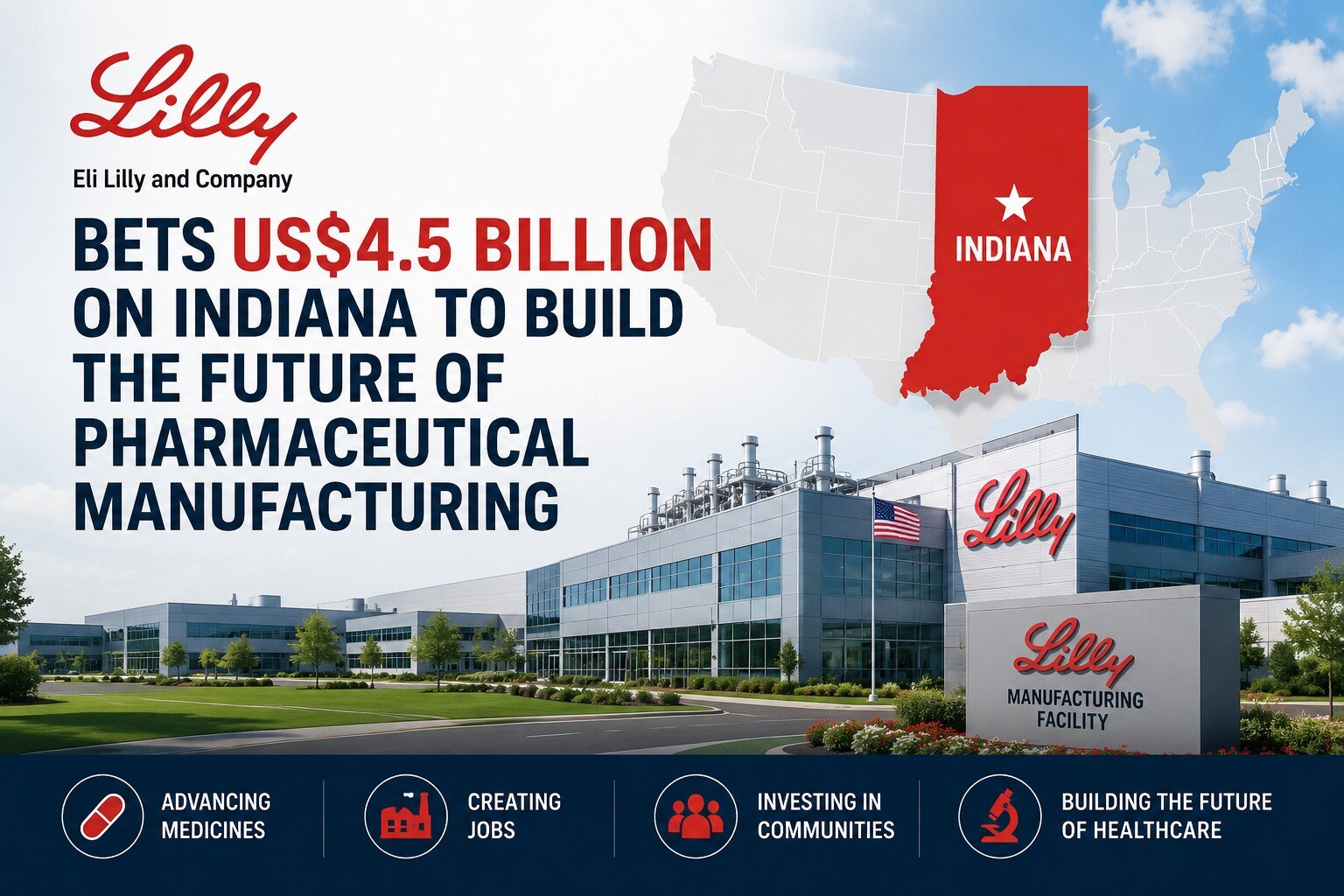
Eli Lilly and Company has announced an additional US$4.5 billion investment into its Indiana manufacturing network, deepening one of the most aggressive domestic pharmaceutical expansion strategies currently underway in the United States.
At first glance, the announcement appears to be another large scale manufacturing expansion designed to meet surging demand for obesity and diabetes therapies. But beneath the headline lies something far more consequential: a strategic restructuring of how the future of medicine will be manufactured, secured, and commercialised.
The investment arrives at a pivotal moment for the pharmaceutical sector, where companies are simultaneously confronting unprecedented demand growth, geopolitical uncertainty, supply chain vulnerabilities, and the accelerating transition toward advanced therapeutics including genetic medicines and precision biologics.
For Lilly, Indiana is no longer simply a manufacturing base. It is becoming the nucleus of a next generation pharmaceutical production ecosystem.
Manufacturing Has Re Emerged As A Strategic Weapon
For decades, pharmaceutical success was largely driven by scientific discovery, intellectual property, and commercial reach. Manufacturing was often viewed as a backend operational function.
That paradigm is changing rapidly.
The rise of GLP 1 based obesity therapies has exposed one of the industry’s biggest vulnerabilities: global manufacturing capacity constraints. Demand for obesity and metabolic medicines has expanded at a pace few companies anticipated, creating supply shortages, delayed market access, and enormous competitive pressure.
Lilly’s latest investment underscores an industry wide realisation that manufacturing scale itself is becoming a competitive differentiator.
The company is not merely building factories. It is building strategic control over future supply.
By significantly expanding active pharmaceutical ingredient production, biologics infrastructure, and advanced therapy manufacturing capacity within the United States, Lilly is positioning itself to reduce external dependencies while accelerating speed to market for future therapies.
This represents a major shift from the previous era of highly globalised pharmaceutical manufacturing networks that relied heavily on fragmented international sourcing models.
The Obesity Drug Boom Is Reshaping Capital Allocation
The commercial success of obesity therapies has fundamentally altered investment priorities across global pharma.
Treatments once viewed as niche metabolic therapies are now being projected to generate hundreds of billions of dollars in long term market value globally. The obesity category is rapidly evolving into one of the largest therapeutic markets in pharmaceutical history.
Lilly’s expansion reflects the industry’s understanding that existing manufacturing infrastructure is insufficient to support future patient demand.
More importantly, the company is using the extraordinary cash generation from its current metabolic portfolio to finance long horizon infrastructure investments that extend far beyond today’s blockbuster products.
This is not simply about meeting current demand for incretin therapies. It is about creating industrial scale capability for the next generation of biologics, combination therapies, and precision medicines that will define pharmaceutical competition over the next decade.
Indiana Is Emerging As A Global Life Sciences Powerhouse
The scale of Lilly’s commitment is also transforming Indiana into one of the most strategically important pharmaceutical manufacturing clusters globally.
The state is increasingly evolving into a vertically integrated life sciences ecosystem that combines:
- Active pharmaceutical ingredient production
- Advanced biologics manufacturing
- Genetic medicine infrastructure
- Process development capabilities
- Commercial scale production
- Automation and digital manufacturing technologies
This concentration of infrastructure creates operational advantages that are difficult for competitors to replicate quickly.
In the global race to secure pharmaceutical manufacturing leadership, geographic clustering matters. Talent ecosystems, regulatory familiarity, supplier networks, logistics access, and production agility all improve when manufacturing infrastructure becomes concentrated within specialised regional hubs.
Lilly’s expansion effectively positions Indiana alongside emerging global biopharma corridors competing for long term manufacturing dominance.
Advanced Therapies Are Moving Into Industrial Scale Manufacturing
Perhaps the most strategically important aspect of the investment is Lilly’s growing focus on advanced therapies and genetic medicines.
Historically, many advanced therapies remained confined to specialised research environments due to manufacturing complexity, scalability challenges, and cost barriers.
That environment is changing.
The establishment of dedicated advanced therapies infrastructure signals that Lilly sees genetic medicines not as experimental extensions, but as commercially viable pillars of future healthcare delivery.
This transition matters because manufacturing remains one of the largest barriers to widespread commercial adoption of gene based therapies. Scientific breakthroughs alone are insufficient without scalable production systems capable of delivering therapies reliably, efficiently, and at commercial volumes.
By investing now, Lilly is attempting to establish manufacturing leadership before the advanced therapies market reaches full commercial maturity.
The implications extend beyond oncology and rare diseases. The infrastructure being built today could support future applications across metabolic disorders, autoimmune diseases, neurological conditions, and regenerative medicine.
Geopolitics Is Redefining Pharmaceutical Supply Chains
The timing of Lilly’s announcement is equally important.
Global pharmaceutical companies are increasingly recalibrating supply chains amid rising geopolitical tension, trade uncertainty, and growing scrutiny around foreign manufacturing dependencies.
The pandemic exposed the fragility of globally distributed pharmaceutical supply systems. Since then, governments and industry leaders have accelerated efforts to localise strategic healthcare manufacturing capabilities.
Lilly’s investment reflects this broader industrial shift toward supply chain resilience and manufacturing sovereignty.
The message is clear: future pharmaceutical leadership will depend not only on innovation pipelines, but also on who controls the infrastructure capable of producing therapies at scale during periods of disruption.
This dynamic is likely to influence investment strategies across the wider biopharma sector, particularly as countries compete to secure domestic manufacturing capacity for critical medicines.
The Industry Is Entering A New Manufacturing Cycle
Lilly’s Indiana expansion may ultimately be remembered as part of a larger turning point for global biopharma manufacturing.
For years, the industry prioritised lean manufacturing models, outsourcing efficiency, and geographically dispersed production networks. Today, the emphasis is shifting toward resilience, vertical integration, digital manufacturing, and regional control.
The next decade of pharmaceutical competition is unlikely to be decided solely in research laboratories.
It will also be determined by:
- Manufacturing agility
- Supply chain security
- Advanced therapy scalability
- Automation readiness
- Regulatory adaptability
- Regional production strength
Lilly’s latest investment demonstrates how major pharmaceutical companies are beginning to rebuild industrial infrastructure around these realities.
Beyond Expansion, A Long Term Strategic Positioning Move
Ultimately, Lilly’s additional US$4.5 billion commitment is not simply a capacity expansion announcement.
It is a declaration about where the future of pharmaceutical manufacturing is heading.
The company is using today’s metabolic therapy success to build tomorrow’s therapeutic infrastructure — one designed not only for current blockbuster demand, but for a future increasingly shaped by genetic medicines, AI enabled manufacturing systems, precision therapeutics, and resilient regional supply chains.
For the broader global life sciences industry, the announcement reinforces a growing reality: manufacturing is no longer a supporting function in pharmaceutical strategy.
It is becoming the strategy itself.