02 March 2026 | Monday | News
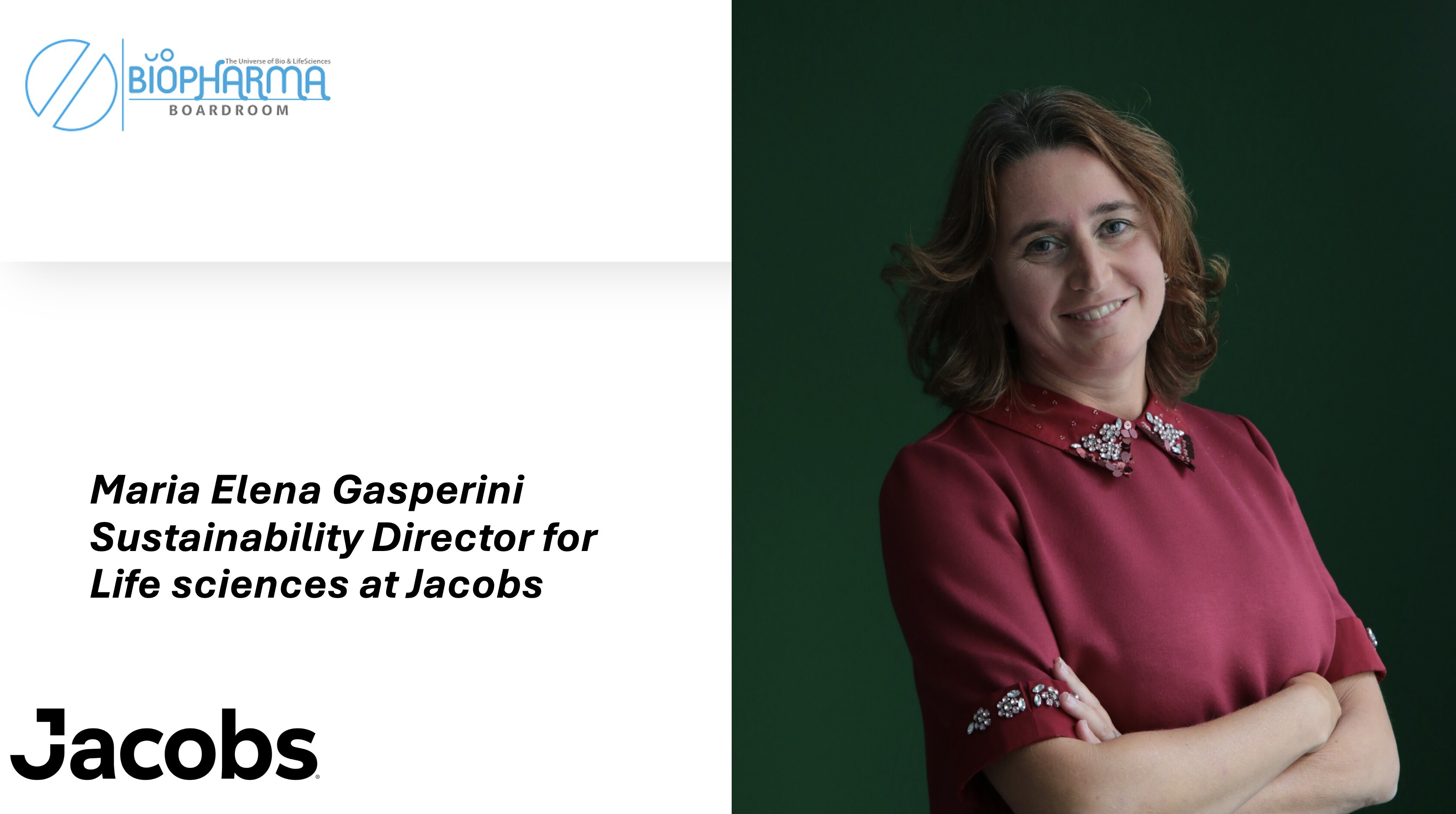
As life sciences companies scale biologics, advanced therapies, and personalized medicines, sustainability has moved from aspiration to operational imperative. From decarbonizing complex global supply chains to embedding environmental governance into facility design, the sector faces mounting pressure to align growth with climate responsibility. In this BioPharma Boardroom interview, Maria Elena Gasperini, Sustainability Director for Life Sciences at Jacobs, outlines the structural, digital, and cultural shifts required to achieve carbon-neutral laboratories and resilient, resource-efficient biomanufacturing — without compromising quality, compliance, or performance.
From your perspective, what are the most significant sustainability challenges facing life sciences laboratories and biomanufacturing facilities today, particularly as the industry scales advanced therapies and biologics production?
The most pressing sustainability challenge is the need to decarbonize while simultaneously improving energy and water efficiency across a rapidly expanding global footprint. As companies accelerate the production of biologics and advanced therapies, the environmental demands placed on laboratories and biomanufacturing facilities are rising faster than the industry’s ability to adapt through traditional improvement models. Central to this challenge - and often the elephant in the room - is the decarbonization of Scope 3 emissions. In many pharmaceutical companies, upstream and downstream activities together represent more than 80% of the total carbon footprint, yet most current efforts still prioritize Scope 1 and 2 reductions. Meaningful progress demands a shift in focus toward the full value chain, supported by stronger supplier engagement, transparent data sharing, and collaborative approaches that extend far beyond organizational boundaries.
Equally fundamental is the need for robust governance. Sustainability cannot remain a standalone initiative or a corporate commitment that sits apart from daily operations. It must be embedded into the same systems that govern quality, safety, compliance and investment decisions. Without integrated governance, clear ownership and aligned incentives, high-level ambitions often fail to translate into consistent decisions at the facility level. Only when sustainability becomes intrinsic to operational culture can organizations ensure that environmental considerations are systematically incorporated into design choices, procurement processes, production methods and long-term capital planning.
A critical, often underestimated enabler of this shift is the move to paperless batch records - electronic Batch Records (eBR). This should no longer be viewed as an “innovative” frontier; it is a foundational capability that many other industries adopted years ago. Yet, in a significant number of sites, eBR adoption is still at an initial stage. The result is fragmented data, slow investigations, and large volumes of paper documentation with associated storage, handling, and compliance burdens. Transitioning to eBR now carries dual urgency: from a sustainability perspective, it reduces paper consumption, printing, archiving space, and transport, and cutting rework from documentation errors; and from a digital perspective it establishes trustworthy, structured datasets that power analytics, digital twins, AI-driven optimization, and portfolio benchmarking. To succeed, organizations must resource validation and change control adequately, harmonize master data and naming conventions across sites, and integrate MES with QMS, LIMS, ERP, and equipment data layers. Without this, companies will continue to struggle with cross-site data consistency and will under realize both sustainability and performance benefits.
Governance challenges are compounded by the rapid expansion of biologics and advanced therapy manufacturing. The sector is constructing highly specialized facilities at an unprecedented pace, and these sites are inherently energy intensive. Increasing production capacity while reducing environmental impact requires integrated planning from the earliest stages of concept and design.
Traditionally, much of the industry’s attention has centered on reducing energy consumption - understandably, given the high loads associated with cleanrooms, HVAC systems and controlled environments. However, focusing on energy alone leaves a significant gap, particularly regarding water stewardship. Pharmaceutical manufacturing depends on water-intensive processes, from purification and cleaning to environmental systems. In many regions, water scarcity is evolving into a strategic risk that demands a reassessment of long-established practices. While the industry is often cautious about modifying validated processes, emerging technologies in water recycling, reuse and system optimization can deliver measurable improvements without compromising quality or regulatory compliance.
Advanced therapy facilities, despite being smaller and more modular, present their own considerations. Their design often mirrors laboratory environments more than traditional manufacturing plants, which can make sustainability measures easier to integrate. Yet here too, intentional planning is required to ensure that energy efficiency, material selection and supply chain impacts are managed proactively rather than treated as secondary considerations.
Carbon-neutral labs remain an ambitious goal for many organizations. What practical strategies and infrastructure design principles can companies implement today to meaningfully reduce energy consumption and carbon emissions without compromising operational performance or regulatory compliance?
Environmentally friendly labs are often seen as aspirational, yet they are increasingly achievable with the right design approach. Laboratories are energy-intensive environments, but they are also buildings with predictable usage patterns and defined performance requirements.
HVAC systems represent the most significant opportunity for reducing energy consumption. Traditional laboratory design has favored constant air change rates and continuous system operation to ensure compliance and safety. Today, more sophisticated controls allow airflow and ventilation rates to adjust dynamically based on occupancy and real-time conditions. Optimizing fluid distribution systems further enhances efficiency.
Design teams can also refine temperature and humidity parameters within acceptable regulatory ranges rather than defaulting to overly conservative set points. Small adjustments, when applied consistently across large facilities, translate into significant reductions in energy demand.
Robotics and automation are also reshaping sustainability performance in laboratories and cleanrooms. The introduction of robotic platforms capable of executing routine or repetitive process steps offers several advantages. First, robotics reduce the number of people required inside clean rooms, which in turn allows for smaller areas, lower air change volumes, and reduced gowning and de-gowning cycles. Smaller controlled spaces directly translate into lower HVAC loads and improved energy efficiency.
Sustainability measures must be put in place during concept and schematic design. Retrofitting solutions later is more complex and less cost-effective.
Laboratories offer greater flexibility in achieving carbon neutrality because their core function is less dependent on heavy industrial processes. With advanced energy modeling and lifecycle carbon assessments, engineering and operations teams can work together to reduce emissions substantially without compromising on productivity.
How is the shift toward more complex modalities - such as cell and gene therapies, mRNA and personalized medicines - reshaping the sustainability equation for manufacturing, and what opportunities exist to embed sustainability early in facility and process design?
This shift is transforming manufacturing in ways that fundamentally alter the sustainability equation. These therapies rely on highly specialized, small‑batch processes that increasingly favor compact, flexible production environments, including modular container-based units as well as small laboratory-scale facilities that can be located near or within hospital grounds. This proximity to patients shortens logistics pathways, reduces transport-related emissions and enables faster turnaround for time‑critical personalized treatments.
Both modular units and small labs offer a rare opportunity to embed sustainability from the outset. Because they are typically new, purpose-built installations, their energy systems, building envelope, control strategies and material selection can be optimized for low‑carbon performance. Their size and repeatability also make them ideal testbeds for innovations such as high-efficiency HVAC, integrated heat recovery and intelligent building systems.
A defining feature of advanced therapy production is the extensive use of single‑use technologies. These closed, disposable systems reduce contamination risk and dramatically lower water consumption by eliminating the need for traditional cleaning, sterilization and CIP/SIP processes. For small, distributed manufacturing sites - especially those situated in hospital environments - this reduction in water usage is a significant operational advantage, simplifying infrastructure needs and improving process reliability.
However, the shift toward single‑use systems brings a growing sustainability challenge: plastic waste. Disposable bags, tubing sets, filters and bioreactor liners are typically contaminated with biological materials and must be managed as hazardous waste. This usually means incineration, as current recycling technologies cannot handle the complex material compositions and contamination risk associated with bioprocessing plastics. As a result, the waste footprint of advanced therapy manufacturing is emerging as one of the industry’s most complex sustainability issues.
Advances in chemical recycling, decontamination technologies and circular‑economy models may eventually enable the recovery of materials from single‑use systems. Collaboration among suppliers, recyclers, regulators and manufacturers will be essential to unlock this potential. In time, the integration of take‑back schemes or closed-loop recycling could help transform this waste stream into a more sustainable system.
Digitalization and smart infrastructure are increasingly seen as enablers of sustainability. How are technologies such as digital twins, advanced monitoring systems and AI-driven optimization helping life sciences companies improve energy efficiency and resource utilization?
Digitalization is emerging as an important enabler of sustainability, but the sector is still in a transition phase and implementation and impact remain uneven.
Digital twins and energy-modeling tools help teams make better design decisions by simulating how buildings and utilities might perform under different conditions. In operations, they can highlight inefficiencies and test adjustments virtually but in practice, many systems are still limited, functioning more as visual dashboards than fully predictive tools.
Advanced monitoring systems and expanded sub-metering provide greater visibility into where energy and utilities are consumed. AI can support anomaly detection and more proactive maintenance. However, a major barrier remains data consistency across multiple sites. Differences in metering setups, sensor calibration, data naming and quality mean organizations often struggle to compare performance across regions or portfolios. Without standardization, digital insights remain fragmented.
Another recurring challenge is that digital tools are often used during design but not fully integrated into operations. Governance, clear ownership and trained teams are essential to convert data into action and many companies are still developing these capabilities.
Sustainability is no longer only an environmental issue but also a strategic and financial one. How are ESG expectations from investors, regulators and partners influencing decision-making in facility design, operations and long-term capital planning across the life sciences sector?
Expectations are increasing, and the industry is beginning to integrate sustainability into decision-making, but the depth and speed of adoption vary widely. For many organizations, sustainability is gaining visibility in governance and capital planning, yet it is still one of several competing priorities alongside cost, operational risk, compliance and time-to-market.
Companies increasingly recognize that the choices made during early concept design - energy strategy, utility sizing, materials selection - will define operational emissions for the next 20–30 years. Unlike quality or safety, sustainability is still transitioning from an initiative toward a fully embedded discipline.
Where the life sciences industry truly stands out, however, is in its culture of collaboration, which is becoming one of the most powerful mechanisms for advancing sustainability. Pharmaceutical companies, despite competing commercially, have a history of working together in pre-competitive spaces to align standards, share data and solve systemic challenges. This collaborative mindset is now extending into sustainability.
Industry consortia, technical working groups, supplier engagement platforms and multi-stakeholder partnerships are enabling companies to compare methodologies, test new approaches and collectively define what “good” looks like. Although these efforts often require time to build consensus, the payoff is significant:
once a standard or best practice is agreed, it tends to shape expectations for the entire sector, with examples including harmonized approaches to Scope 3 data collection, shared methodologies for product carbon footprinting, common specifications for greener materials, and joint procurement programs for renewable energy or low-carbon technologies.
Looking ahead, what key innovations, policy shifts or industry mindset changes will be required over the next decade to accelerate the transition toward truly sustainable and carbon-neutral life sciences infrastructure globally?
The most important transformation ahead is organizational. Sustainability must be embedded in all company policies, treated with the same seriousness as quality and safety, and integrated into the governance structures that shape investment and operational decisions. This cultural shift is essential for aligning day-to-day practices with long-term environmental commitments.
The area where this mindset shift is most critical is product development. Integrating sustainability at this stage allows organizations to reduce resource use, improve process efficiency and lower emissions long before products reach manufacturing scale. Green chemistry will play a pivotal role, encouraging the reduction of hazardous substances, the use of renewable or benign solvents, improved atom economy, reduced waste generation, inherently safer reactions and the adoption of biocatalysis or continuous processing where feasible. These principles guide chemists and process engineers to design routes that optimize both performance and environmental impact.
The industry must also confront the growing challenge posed by PFAS. Widely used across R&D, QC and manufacturing for their functional properties, PFAS pose sustainability and compliance risks due to their persistence and difficulty to remediate. A forward-looking approach requires systematic PFAS mapping, alternatives assessment, phase-out strategies where feasible, supplier disclosure and investment in analytical capabilities. Where substitutions are not yet possible, strict minimization and containment practices are essential. Over time, collaboration across suppliers, regulators and industry groups will be critical to accelerating viable alternatives.
Another important but often overlooked aspect of sustainability is optimizing internal logistics across global site networks. Many multinational life sciences facilities have evolved over decades in different geographies, resulting in inconsistent layouts and material flows. By mapping internal movements of materials, equipment and personnel, companies can identify redundancies and unnecessary distances. Streamlining these flows reduces carbon emissions and operational risk while improving overall efficiency across the global network.
In parallel, the use of product carbon footprinting (PCF) as a decision framework will become increasingly important. PCF enables teams to understand the lifecycle impact of chemicals, materials, process routes and supplier choices, guiding product development and procurement strategies that reduce Scope 3 emissions , which are the most significant portion of the industry’s footprint.









© 2026 Biopharma Boardroom. All Rights Reserved.