14 January 2026 | Wednesday | Interview
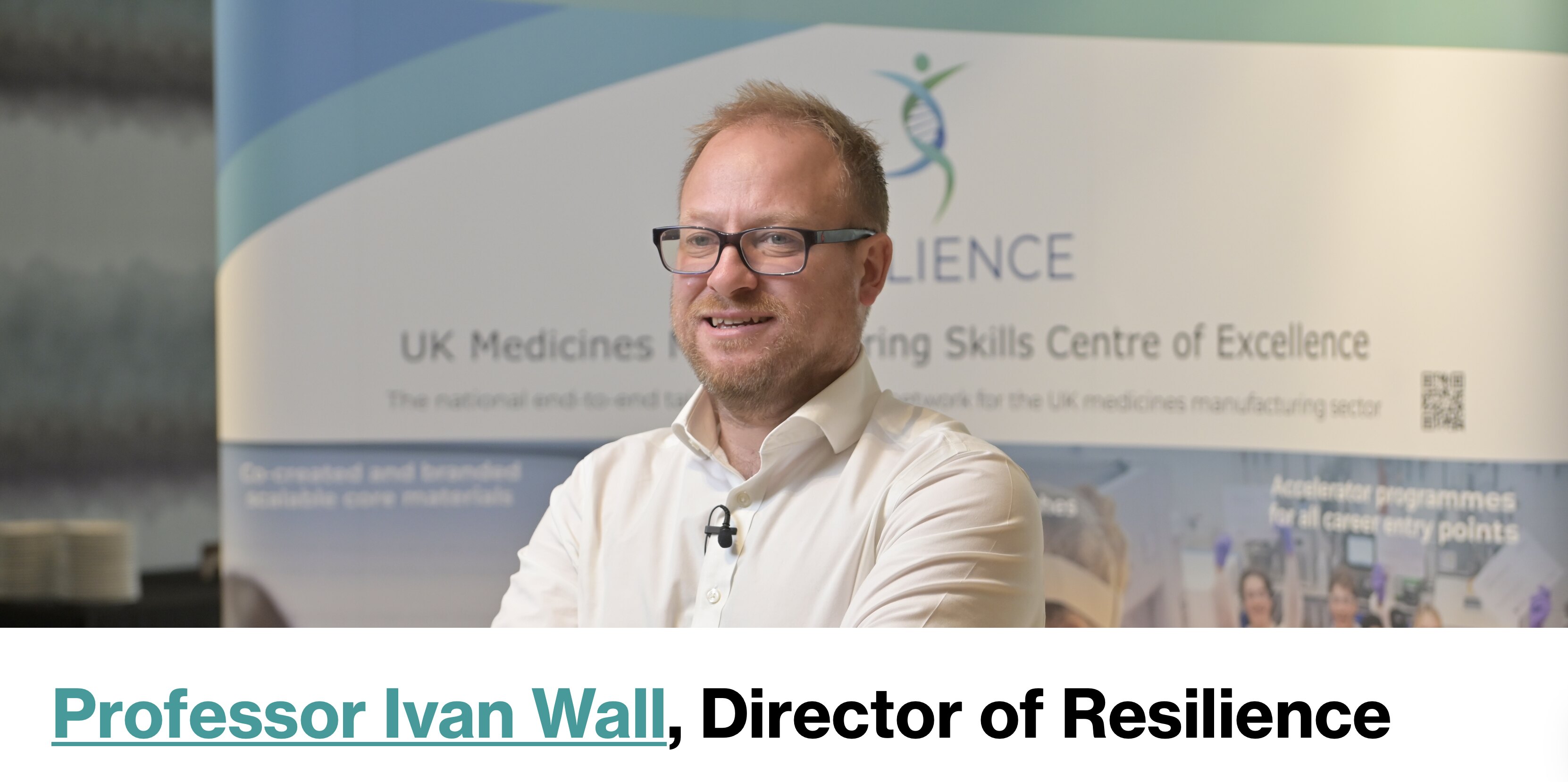
As the UK races to secure its position as a global leader in advanced therapies, a growing skills gap threatens to undermine billions in investment and patient access to critical medicines. In this interview with Biopharma Boardroom, Professor Ivan Wall, Director of the UK government–backed Resilience programme, explains why immersive virtual reality is emerging as a powerful solution to train, inspire, and scale the next generation of biomanufacturing talent—from primary school classrooms to GMP-ready facilities.
Resilience is tackling one of the most structural challenges in advanced medicines manufacturing the skills gap. From your perspective, how serious is this issue today and what risks does it pose to the UK life sciences ambition if it is not addressed quickly?
Advanced medicines manufacturing is suffering from an acute skills gap, and not enough young people are entering the sector. The challenges are significant, ranging from encouraging young people to take STEM subjects at school through to developing training programmes that teach the necessary skills for working in the sector.
Experts estimate that the UK’s medicines manufacturing sector is facing a shortfall of 145,000 workers over the next 10 years. That’s 70,000 new (and 75,000 replacement) jobs available to those coming through the current education system.
We’re already seeing the impacts of this; unprecedented worldwide drug shortages are making headlines as patients struggle to get hold of vital drugs.
For some conditions like ADHD, which is experiencing a particular drug shortage, patients often experience a worsening of core symptoms like poor focus and executive dysfunction, leading to increased difficulty managing daily tasks like chores, work and relationships.
In worst case scenarios, drug shortages have led to death. On 14th December 2022, Ava Grace Hodgkinson died after the amoxicillin which was prescribed to her was out of stock at her pharmacy.
The risk to the UK’s life sciences ambition is also great. In recent months alone, Merck scrapped a £1 billion investment in the UK, AstraZeneca has paused projects, and Eli Lilly has put a £279 million investment on hold, citing a need for "significant and sustainable change" in the UK life sciences environment.
While the government has recognised some critical issues facing the UK’s vital life sciences sector, they need to accept that it’s not enough to invest in buildings and equipment; we need future generations of trained, motivated, and educated young people to work in the sector too.
You are using immersive virtual reality to replicate one of the UK’s most advanced manufacturing environments. What are the most important differences in how students learn inside a VR lab compared with a traditional physical training facility?
Gaining access to laboratories or advanced manufacturing facilities for training is inevitably disruptive and expensive – people must travel there, materials are consumed, training staff must be on-hand, working days are interrupted. VR has the ability to simulate real world environments in which it would otherwise be impractical, disruptive, or expensive to experience – medicines manufacturing is a prime example.
Flexibility is the most significant difference between a VR lab compared with a traditional physical training facility. Training time is on-demand, unlimited, and can be repeated at will. Perhaps obviously, there’s no need to travel to an actual manufacturing site – and of course no expensive consumables need to be used.
Critically, training can be standardised across geographies and sites, and there’s no limit on class sizes. Hundreds of students can practice the manufacture of products that would be too expensive to produce in even a small batch as a training exercise in a real-world environment.
From cleanrooms to complex manufacturing tools, a VR-based tour of a real-world facility allows you to explore every corner with unprecedented detail and precision.
One of the most distinctive aspects of Resilience is that even primary school children can be introduced to medicines manufacturing. Why is early exposure so important and how does it change the way young people think about careers in science and biomanufacturing?
For early years education, even into secondary age children, it’s more about inspiration; helping to stimulate interest in STEM subjects, to encourage a pathway, and interest in, the wider life sciences industry. As students refine their education pathway, we need to recognise the importance of acquiring depth of knowledge and applying that knowledge.
In 2013 OFSTED warned that schools were not giving “adequate careers advice to students” leaving unfilled opportunities in industries where the demand for skilled jobs is high. How will we inspire the next generation of medicine makers if the only medical careers they’re aware of are doctors and nurses? Careers advice and inspiration should be much more integrated into everyday teaching at every age.
Too often we hear of education being more about learning facts and passing exams, rather than preparing young minds for a future career. The evidence from many young people who have used it is that VR is a highly engaging technology that enhances learning – Resilience helps students gain knowledge and skills in relation to an actual career that needs more skilled workers.
Advanced therapy manufacturing demands precision, compliance and deep process understanding. How does VR help build confidence and operational readiness before a trainee ever enters a live GMP environment?
The VR environment used in the Resilience training programme is based on one of the most advanced facilities in the country, the Cell & Gene Therapy Catapult’s manufacturing centre in Stevenage.
With VR it is possible to learn a wide range of vital practices, without being in a real facility. Gowning and cleaning are two examples of simple, yet vitally important activities. But to use a real, working lab to practice gowning and cleaning would be a waste of space and resources that could be used by trained medicine makers to create products that are in extraordinarily high demand.
Much of the core training is about orientation, building confidence, familiarity, and process knowledge, so VR is a highly efficient and cost-effective delivery method.
The UK government has invested £4.3 million into the Resilience programme. What does success look like at the end of two years in terms of workforce readiness, industry adoption and the UK’s competitiveness in cell and gene therapy manufacturing?
The UK is already at the forefront of the science behind biologics, advanced therapy medicinal products (ATMPs) and personalised therapies, but this needs to be matched in manufacturing capability, if our full potential is to be realised.
‘Biologics’ (which includes vaccines, blood components, somatic cells and tissues) may offer the most effective means to treat a variety of currently untreatable conditions. But they tend to be heat sensitive and susceptible to contamination, so the initial manufacturing steps are especially sensitive.
On top of that, advanced therapy medicinal products (ATMPs), based on genes, cells or tissues, promise groundbreaking opportunities for the treatment of diseases. But here too, there are significant manufacturing challenges.
Finally, we are seeing some ground-breaking, personalised therapies. However, these are produced in multiple small batches, which means production is costly, difficult to reproduce at scale, and requires highly skilled operators.
Results from the first year of Resilience are a great indicator of what success looks like for us. 1,500 trainees from across the medicines manufacturing industry and education have been reached, and another 15,000 through outreach and engagement programmes.
True success for Resilience is a pipeline for creating the next generation of medicine makers in the UK.
Looking ahead, how do you see virtual reality and digital training platforms reshaping education and the economics and scalability of medicines manufacturing across the UK and globally?
VR/AR technology will continue to evolve, to become a key enabler for training in industry and manufacturing.
The leading payers are developing wireless HD headsets, using ever more powerful processors. They will undoubtedly soon integrate AI, and 5G will allow more devices and larger communities to be connected.
For advanced medicines manufacturing, this means even better training and an even more exciting and engaging career path for young people.
In short, VR/AR technology will help to create a generation of workers equipped with the necessary skills for working in advanced medicines manufacturing.



© 2026 Biopharma Boardroom. All Rights Reserved.