23 July 2026 | Thursday | Expert Opinion
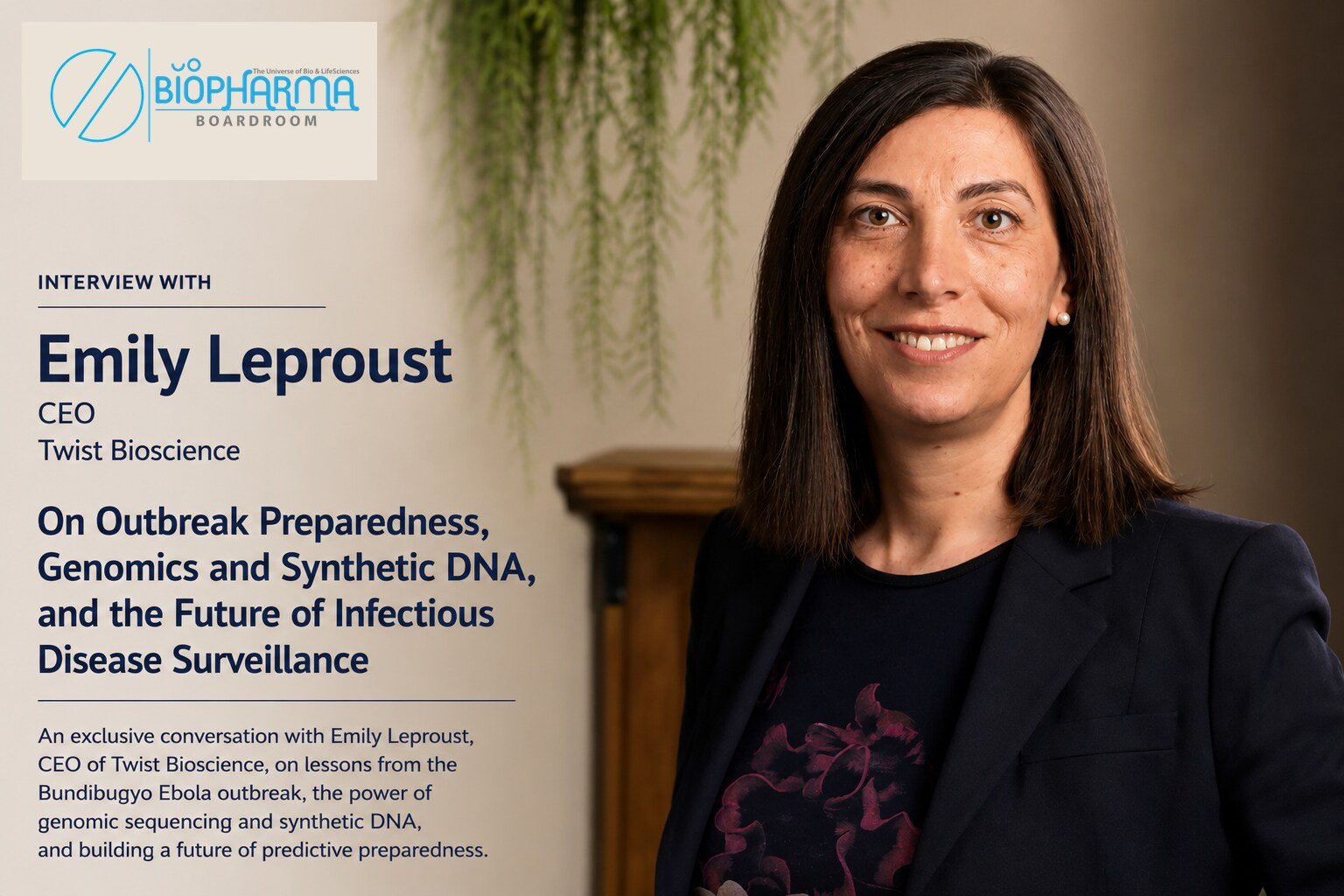
The recent Bundibugyo Ebola virus outbreak underscored the limitations of relying solely on highly targeted diagnostics, highlighting the need for more adaptable approaches to infectious disease surveillance. In this interview with BioPharma BoardRoom, Emily Leproust, CEO of Twist Bioscience, explains how genomic sequencing, synthetic DNA and AI are strengthening outbreak preparedness, accelerating the development of diagnostics and medical countermeasures, and helping public health systems move from reactive responses toward predictive surveillance
The recent Bundibugyo virus outbreak highlighted how initial diagnostic tests failed because they were designed for a different Ebola species. What does this incident reveal about the current limitations of outbreak diagnostics, and what lessons should public health systems take away from it?
The Bundibugyo outbreak is an important reminder that outbreaks don't always follow our assumptions. The initial PCR test performed exactly as designed by looking for the Zaire strain of Ebola. The challenge was that the outbreak was caused by a different species, one that required a broader approach to identify. The PCR test didn’t fail; the diagnostic strategy fell short.
That illustrates both the strength and the limitation of highly targeted diagnostics. PCR remains a valuable tool in because of its sensitivity and specificity. But specificity can become a limitation when a pathogen evolves or when an outbreak is caused by something unexpected.
The lesson for public health is not that we should replace PCR, but that we need complementary technologies. Broad genomic sequencing, like that enabled by Twist’s Comprehensive Viral Research Panel, provides the flexibility to identify pathogens beyond what we already know to look for. Preparedness should mean having a diagnostic strategy that combines speed with adaptability, because the next outbreak may not resemble the last one.
Synthetic DNA and broad genomic sequencing played an important role in identifying the pathogen quickly. How are these technologies changing the way healthcare systems respond to emerging infectious diseases compared with traditional diagnostic approaches?
Historically, infectious disease diagnostics have been reactive. We identify a pathogen, develop an assay around it and then deploy that assay broadly. That model works well when you're dealing with a known threat.
Genomic sequencing with NGS panels changes that paradigm because it allows scientists to identify pathogens without requiring complete prior knowledge of exactly what they're looking for. In the case of the rare Bundibugyo Ebola strain, the Democratic Republic of the Congo’s Institut National de Recherche Biomédicale (INRB) researchers were able to use whole genome sequencing and the Twist Comprehensive Viral Research Panel to identify the correct strain when PCR tests couldn’t.
Instead of relying on PCR tests specific to certain strains, comprehensive panels that include probes from many reference genomes can help researchers identify myriad strains. The Twist Comprehensive Viral Research Panel includes over one million probes targeting 3,153 viral genomes.
Many countries continue to invest heavily in pandemic preparedness. From your perspective, where should governments and global health organizations prioritize investment to improve early detection and surveillance of novel pathogens?
Preparedness begins long before the next outbreak. Investments should focus on building surveillance systems that can detect emerging pathogens early, before localized events become global crises.
That includes expanding genomic sequencing capacity, strengthening laboratory infrastructure, improving data sharing between countries and supporting bioinformatics capabilities that allow genomic information to be interpreted rapidly.
Equally important is maintaining these capabilities between outbreaks. It's difficult to build expertise during a crisis. We need sustained investment in the scientific infrastructure, workforce and technologies that allow us to respond immediately when new threats emerge.
Once an unknown pathogen has been identified, speed becomes critical for developing diagnostics, vaccines, and therapeutics. How can advances in synthetic biology help compress these timelines while maintaining scientific rigor and regulatory confidence?
The industrialized production of synthetic DNA, RNA and proteins at scale can meaningfully impact how quickly researchers can move from sequence information to actionable research.
Once the genetic sequence of a pathogen is available, access to DNA, RNA and proteins enables scientists to rapidly produce reference materials and controls to validate diagnostic assays and begin evaluating vaccine or therapeutic candidates. Capabilities such as Twist's gene synthesis, synthetic viral controls and cfDNA reference standards help provide researchers with the tools they need to accelerate that work.
We've seen repeatedly over the past several years that biology is becoming increasingly programmable. The ability to rapidly design, build and test biological components allows researchers to compress timelines that once required months into days or weeks, while still following the rigorous scientific and regulatory processes necessary to ensure safety and effectiveness.
Looking beyond Ebola and other viral hemorrhagic fevers, do you believe current diagnostic infrastructure is adequately prepared for future emerging pathogens, or are there still significant technological and operational gaps that need to be addressed?
We've made significant progress since COVID-19, but we are not prepared for future outbreaks.
Many countries have strengthened sequencing capacity and surveillance networks, yet there are still considerable differences in access to advanced diagnostics, laboratory infrastructure and genomic expertise around the world.
Technologically, we need diagnostic systems that are designed with greater flexibility. Operationally, we need stronger coordination across public health agencies, healthcare systems, academic researchers and industry.
Perhaps the most important lesson is that preparedness cannot be built during an outbreak. The technologies that proved valuable in the recent Ebola response were developed years before they were needed. That kind of long-term investment is what ultimately determines how effectively we respond when the unexpected occurs.
Looking ahead, how do you see AI, genomics, and synthetic DNA converging to transform infectious disease surveillance and outbreak response over the next five to ten years? What developments are you most excited about?
We're entering an era where these technologies reinforce one another in powerful ways.
Genomics provides the data. AI helps us interpret that data at scales that would be impossible manually, identifying emerging patterns, predicting potential risks and accelerating biological discovery. Synthetic DNA allows those predictions to be tested experimentally, creating a rapid feedback loop between computation and the laboratory.
Where I see potential is in the possibility of moving from reactive outbreak response toward predictive preparedness. Imagine surveillance systems that can identify concerning genetic changes earlier, AI models that help prioritize which variants warrant immediate attention and platforms that enable researchers to rapidly develop and evaluate new diagnostics or medical countermeasures. These tools together have the potential to make public health systems substantially more agile, enabling earlier detection, faster scientific understanding and more informed decision-making before outbreaks escalate.
The goal isn't simply to respond faster. It's to build a future where we're better prepared because we've invested in platforms that are designed to adapt as biology continues to evolve.
_______



© 2026 Biopharma Boardroom. All Rights Reserved.