25 August 2026 | Tuesday | Interaction
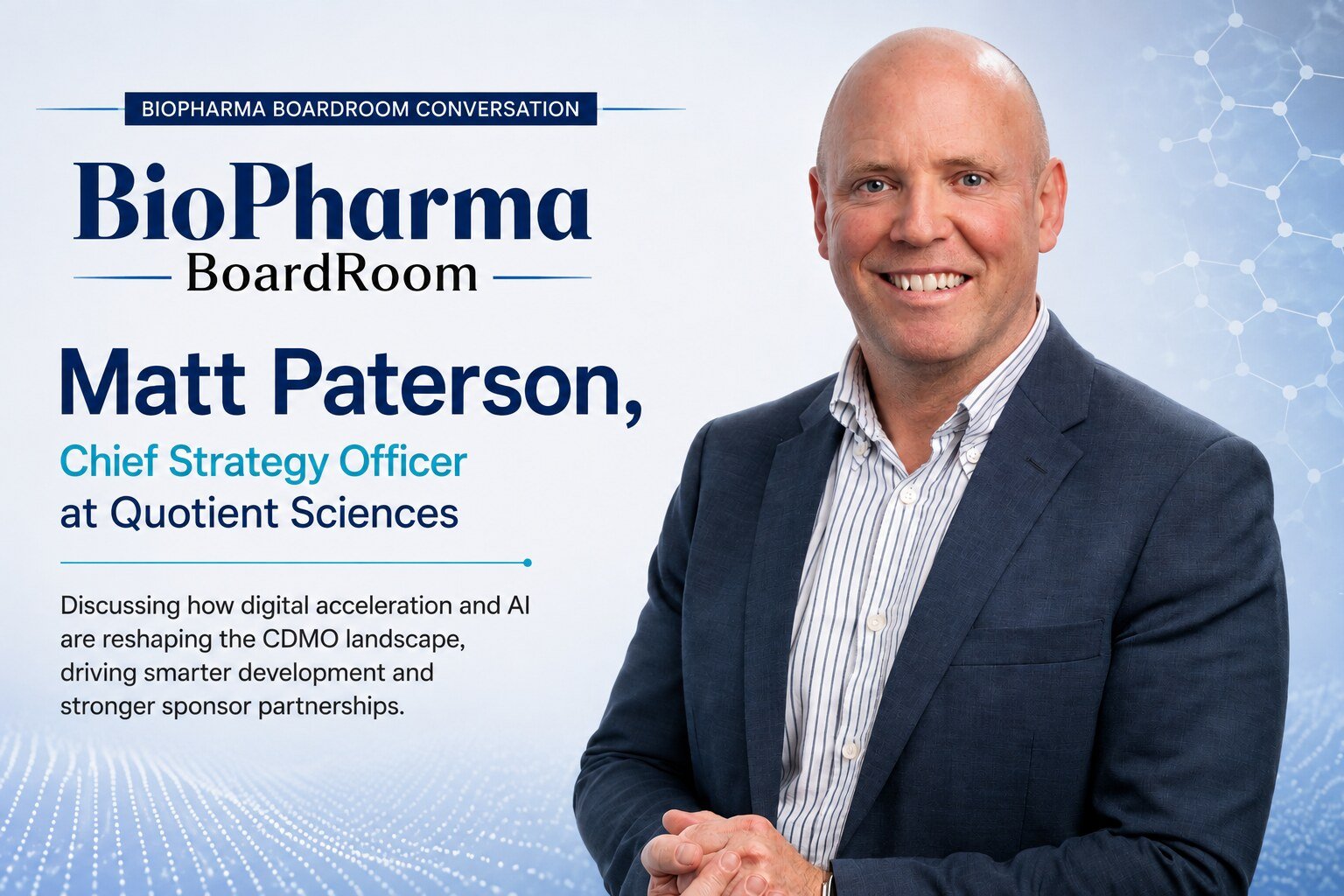
As AI and digital technologies increasingly influence pharmaceutical development, CDMOs are taking on a broader role in helping sponsors improve efficiency, manage risk and accelerate development timelines. In this interview, Matt Paterson, Chief Strategy Officer at Quotient Sciences, explores how AI is already supporting formulation development, where human expertise remains essential, and how CDMOs can help sponsors adopt new technologies while maintaining quality, data integrity and regulatory confidence. He also looks ahead to how digital integration could become a key differentiator in sponsor-CDMO relationships over the next five years.
Digital technologies and AI are rapidly changing expectations across the pharmaceutical industry. From your perspective, how is the role of the CDMO evolving, and what new capabilities are sponsors increasingly looking for when selecting development and manufacturing partners?
Sponsors increasingly want integrated solutions to streamline vendor management and enable faster decision-making. The role of the CDMO is evolving from a service provider to a strategic development partner, especially for those that add additional value with unique or differentiated capabilities, rather than just simply offering capacity.
There is also growing interest in partners that can leverage digital technologies and AI to improve efficiency, reduce risk, and manage R&D timelines and spend throughout a molecule’s development journey.
AI and digital tools promise to accelerate decision-making across development and manufacturing workflows. Can you share examples of where these technologies are already delivering measurable improvements in efficiency, speed, or development outcomes, and where the industry may still be overestimating their near-term impact?
AI demonstrates value in formulation development by helping teams explore formulation options more efficiently. In several completed projects, including a recent clinical trial we have performed with an AI-designed formulation, applying AI to formulation development has aided in reducing experimental burden, shortening development times by 30-50%, and significantly lowering the quantity of drug material required.
However, AI is not effective in isolation. Our approach at Quotient Sciences, for example, emphasizes combining AI-generated insights with expert scientific oversight. This ensures that there is a “human in the loop” at every stage to validate predictions and recommendations from AI models, and that programs remain aligned with regulatory expectations.
As sponsors seek to adopt innovative technologies, many remain concerned about regulatory expectations, data integrity, and operational risk. How can CDMOs help bridge this gap and provide a framework that enables innovation while maintaining confidence in quality and compliance?
CDMOs play an important role as far as helping sponsors adopt new technologies within a framework that supports quality, compliance, and confidence. By integrating innovation into established development workflows, CDMOs can help sponsors realize the benefits of new technologies without compromising quality or data integrity.
While there is understandable excitement about AI, it is human nature to be skeptical of new approaches, particularly in a highly regulated environment where there cannot be compromises to patient safety and product quality. Expectations can also sometimes outpace reality when AI is viewed as a replacement for experimental data, human judgment, or regulatory-grade evidence.
Evidence is the key to bridge the gap, develop understanding and trust. Sponsors need clear proof points that demonstrate, for example, how new technologies perform in practice and how data integrity is maintained. CDMOs can provide this confidence by validating technologies within real-world programs, with datasets and governance frameworks that ensure transparency, traceability, and compliance.
Successful digital transformation often requires more than implementing new technologies—it demands changes in culture, processes, and ways of working. What have been some of the biggest challenges in driving digital acceleration within pharmaceutical development environments, and how can organizations overcome them?
Digital transformation is not solely a technology project: Its success depends on integrating new tools into existing scientific and operational processes while adapting workflows, educating teams and building trust among all stakeholders. Progress is often strongest when companies focus on practical applications that solve development challenges and combine digital capabilities with deep domain expertise.
For example, Quotient Sciences has a dedicated AI/data team that has been working across the business to ensure that AI tools are trialed and onboarded appropriately. Governance policies and procedures facilitate how the organization adopts new tools, and communication about the impact of AI-enabled tools is integrated across a variety of different functions, such as pharmaceutical sciences, data sciences, clinical operations, regulatory, commercial and legal.
Looking toward the next five years, how do you expect AI-enabled development and manufacturing models to reshape sponsor-CDMO relationships? Do you foresee a future where digital integration becomes a key competitive differentiator, and what should sponsors be doing today to prepare for that shift?
Over the next five years, AI-enabled development is likely to make sponsor-CDMO relationships more collaborative and data-driven. Digital tools will increasingly support formulation design, process optimization, and development decision-making, creating opportunities to shorten timelines and improve predictability. As these capabilities mature, digital integration could become a significant differentiator when selecting a partner.


© 2026 Biopharma Boardroom. All Rights Reserved.