16 September 2026 | Wednesday | News
As advanced therapies move from development towards commercial scale, quality is becoming far more than a regulatory checkpoint. It is increasingly a strategic discipline that must be embedded across product development, manufacturing, technology transfer and supply chains from the outset.
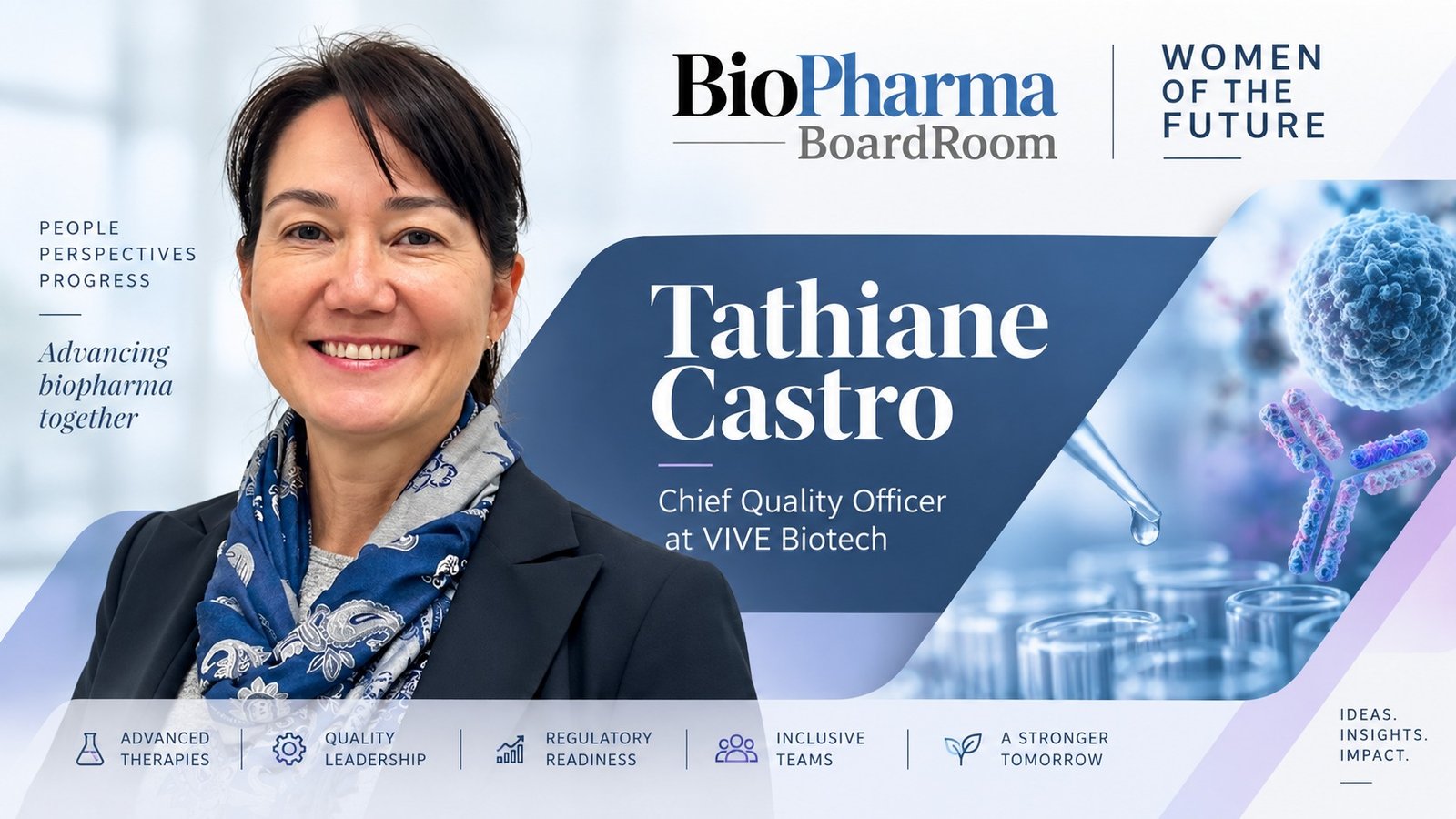
In this Women of the Future conversation with BioPharma BoardRoom, Tathiane Castro, Chief Quality Officer at VIVE Biotech, shares her perspective on building quality into increasingly complex therapies, using data and digitalisation to strengthen regulatory readiness, and creating teams where people are empowered to challenge assumptions and raise concerns. She also reflects on her journey as a woman in executive leadership and offers a clear message to the next generation: start operating at the next level before you have the title.
As advanced therapies become more complex, how are quality and regulatory expectations evolving alongside these new modalities?
Quality and regulatory expectations evolve as the product evolves. In early development, regulations allow some flexibility because we are still learning about the product and the process. As we move towards pivotal studies and commercial manufacturing, we need stronger process understanding, more robust analytical methods, clearer specifications and good evidence to support any manufacturing changes. It is not only that expectations become higher. Our quality and regulatory strategy needs to mature with the product, the available data and the risk to the patient.
What are some of the biggest quality challenges companies face when scaling innovative biologics and advanced therapies from development into commercial manufacturing?
One of the biggest quality challenges is achieving process maturity by turning a development process into a robust, reproducible and commercially viable manufacturing process. Companies must also maintain consistent product quality by demonstrating that critical quality attributes, including potency, purity and safety, remain controlled under routine commercial conditions. This depends on establishing robust analytical and potency methods that are suitable for product characterization, comparability assessments and routine release testing.
Managing change and technology transfer is another key challenge, particularly when processes move between teams or manufacturing sites or when changes are introduced that require comparability to be demonstrated. Companies also need to build commercial readiness early by securing qualified suppliers, appropriate facilities and equipment, trained personnel, validated systems and sufficient manufacturing capacity well before the final stages of development.
How can companies embed quality into their operations from the earliest stages rather than treating it primarily as a compliance function?
Embedding quality effectively means integrating it from the earliest stages of product and process development, rather than waiting until pivotal studies, good manufacturing practice (GMP) manufacturing or commercial launch. Quality, regulatory, manufacturing, technology and supply chain teams should all be involved in early design decisions so that quality is built into the product and process from the outset, rather than assessed only at release. A clear quality target product profile can then guide the identification of critical quality attributes, process parameters, control strategies and risk-based specifications in line with Quality by Design principles.
Quality should also be treated as a shared business responsibility. Operational teams remain accountable for compliant execution, while quality teams provide independent oversight, specialist expertise and constructive challenge. Regulatory and validation planning should begin early, covering areas such as potency, analytical methods, comparability, process validation, contamination control and stability, with performance monitored through meaningful indicators including right-first-time execution, batch success, investigation effectiveness, process capability and supplier performance.
What role will technology, data and digitalisation play in strengthening quality systems and regulatory readiness?
Technology, data and digitalisation can make quality systems more connected, transparent and proactive. Digital systems can link deviations, CAPAs, changes, training, audits and risk assessments, helping us identify recurring issues earlier. Electronic records, laboratory systems and process monitoring can also improve traceability, reduce manual errors and support faster and more focused reviews, provided the systems are validated and data integrity is assured. Data analytics can help detect trends before they become significant quality events.
All of this helps us identify quality and compliance risks earlier, address them before they become significant issues and maintain continuous regulatory readiness.
How has your experience as a woman in quality and executive leadership shaped the way you build teams and approach decision-making?
My experience has reinforced the importance of leading with both scientific rigour and empathy. Strong quality decisions must be evidence-based, but they also need to be communicated in a way that enables people to act. Working as a woman in quality and leadership has made me particularly aware of the value of inclusive teams, where different professional backgrounds and perspectives can challenge assumptions and improve risk-based decisions.
I aim to build teams where people feel safe to raise concerns, report errors early and disagree constructively because silence is often a greater quality risk than a difficult conversation. Through this, I have learned to be clear and decisive when patient safety, product quality or data integrity is at stake, while remaining collaborative in finding practical and sustainable solutions with the business.
What advice would you offer to women early in their careers who aspire to take on senior quality or executive roles in biopharma?
For women early in their careers who aspire to senior quality or executive roles in biopharma, building deep technical credibility is an important foundation. That means developing a strong understanding of the science, manufacturing process, regulatory environment and the wider business implications of quality decisions. It is also valuable to seek experience beyond the quality function, particularly in areas such as manufacturing, technical operations, supply chain, regulatory affairs and leadership, as executive roles require the ability to think across the whole system. It’s also important to develop the confidence to speak up early, ask difficult questions and make your position clear when quality, patient safety or data integrity may be at risk. Finding strong mentors can also make a significant difference by providing advice, advocating on your behalf, increasing your visibility and helping open the door to stretch assignments and leadership opportunities.
Do not wait until you feel completely ready to pursue a bigger role. Start operating at the next level before you have the title. This means taking on broader responsibilities, supporting your manager, understanding the decisions and challenges of the role and demonstrating your capability through results. This will help you build the confidence, experience and visibility needed to be ready when the opportunity comes.




© 2026 Biopharma Boardroom. All Rights Reserved.