23 June 2026 | Tuesday | Interaction | By editor@biopharmboardroom.com
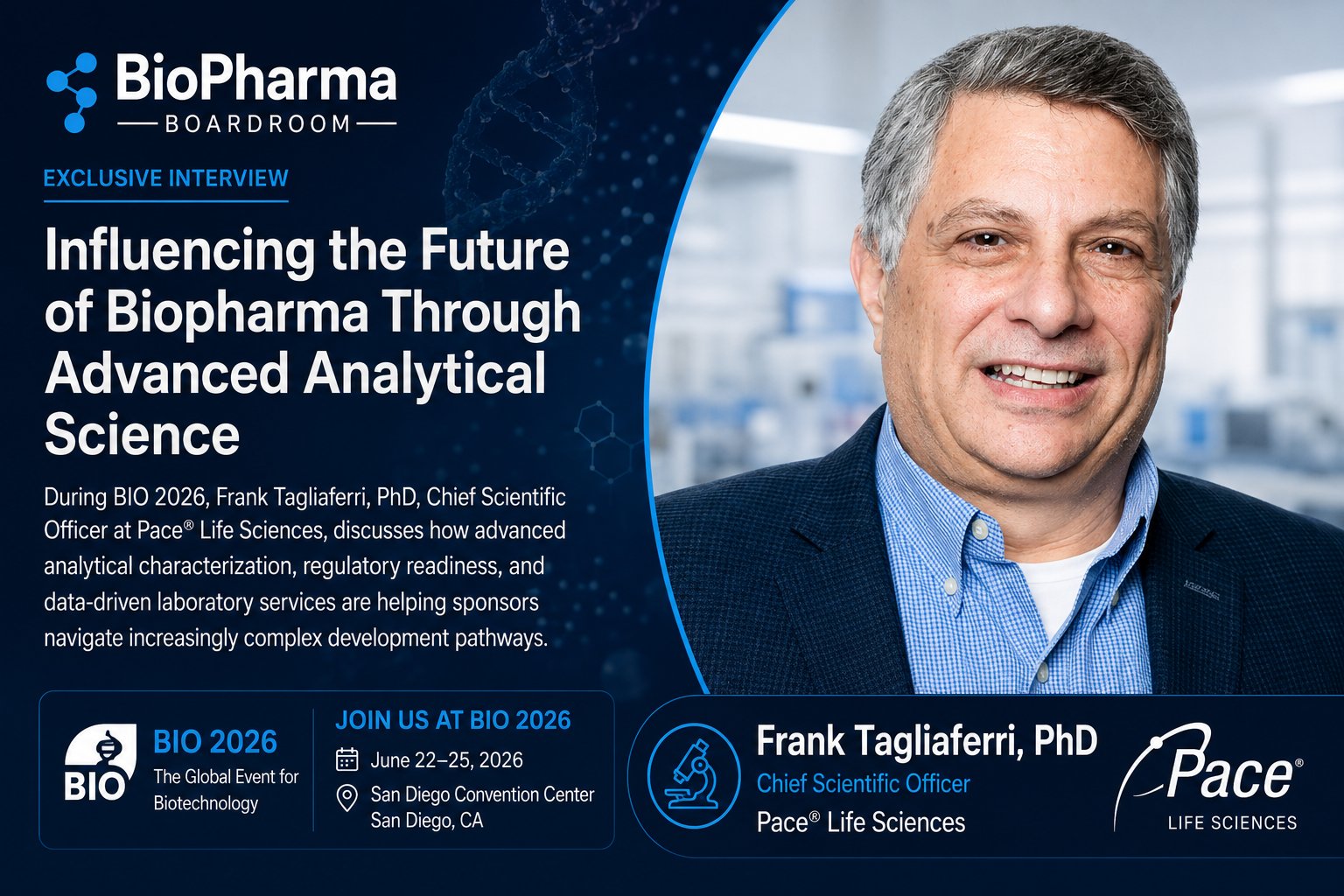
As biopharmaceutical innovation continues to evolve, analytical science is playing a more strategic role in accelerating development and supporting regulatory success. From biologics and nucleic acid therapeutics to cell and gene therapies, sponsors are facing increasing demands for deeper product characterization, stronger comparability data, and globally compliant quality strategies. During BIO 2026, taking place June 22–25 at the San Diego Convention Center, BioPharma Boardroom spoke with Frank Tagliaferri, PhD, Chief Scientific Officer at Pace® Life Sciences, about the industry's shifting analytical landscape. He shares insights on regulatory expectations, advanced characterization technologies, evolving testing requirements, and how laboratory innovation is helping biopharma companies bring complex therapies to patients more efficiently.
Analytical testing and regulatory compliance remain critical industry priorities. What challenges are clients bringing to Pace® most frequently in 2026?
In 2026, the most common client needs are focused on accelerating development and regulatory approval timelines while maintaining scientific rigor, phase-appropriate controls, and global compliance. Across biologics, sterile products, nucleic acid therapeutics, and cell and gene therapies, sponsors increasingly seek support with CMC strategy, analytical development and validation, and comparability assessments. They also require robust approaches for potency and characterization, raw material qualification, lot-release testing, and the control of stability, impurities, and extractables/leachables. At the same time, organizations are navigating heightened expectations around data integrity, digital quality systems, supplier qualification, and lifecycle change management.
Regulatory agencies continue to demand more robust, scientifically justified, and submission-ready data packages that demonstrate product quality, safety, and consistency throughout development. For advanced therapeutic modalities, these challenges become even more significant due to assay complexity, product and process variability, limited platform knowledge, and evolving regulatory expectations. As programs progress toward late-stage development and commercialization, sponsors require increasingly sophisticated analytical and quality strategies to ensure batch-release readiness, process control, and long-term regulatory success.
How is Pace® helping biopharma companies navigate increasingly complex global regulatory expectations?
At Pace®, our combination of deep analytical expertise and regulatory insight helps biopharma companies generate data that is not only complete, but scientifically defensible and submission-ready across global markets. As regulatory expectations continue to evolve, sponsors increasingly need stronger evidence to support product quality, consistency, and lifecycle management.
We help clients navigate these demands by strengthening comparability packages, potency and characterization strategies, stability and impurity programs, and overall CMC readiness. Our teams work closely with sponsors to develop phase-appropriate analytical and quality strategies that align with regulatory expectations while supporting accelerated development timelines.
This is especially important for biologics, cell and gene therapies, nucleic acid therapeutics, and other complex modalities, where regulators are requiring greater scientific rigor, clearer justification of analytical approaches, and more robust control strategies. By integrating analytical excellence with regulatory understanding, Pace® helps clients reduce risk, support successful submissions, and advance products toward commercialization with confidence.
What role is advanced analytical characterization playing in accelerating biologics and complex drug approvals?
Advanced analytical characterization plays a critical role in accelerating biologics and complex drug approvals by providing a deeper, more complete understanding of a molecule's structure, function, and quality attributes. At Pace®, we have long emphasized the importance of comprehensive characterization throughout development, recognizing that a thorough understanding of a product can help mitigate risk, inform CMC strategy, and prevent late-stage surprises that could significantly impact timelines.
Equally important is balancing advanced characterization with the development of robust, phase-appropriate regulated methods needed to support CMC programs and regulatory submissions. Together, these approaches enable sponsors to identify and address potential issues earlier, including molecular instability, product heterogeneity, and other factors that may affect product quality or performance.
As regulatory expectations continue to evolve, advanced analytical characterization has become increasingly central to demonstrating product understanding, comparability, and process control. The more precisely a sponsor can define critical quality attributes, structural complexity, and functional performance, the more effectively they can support process changes, lifecycle management activities, and, in some cases, reduce the need for additional clinical bridging studies. For complex biologics, this level of analytical insight can provide a faster, lower-risk path through regulatory review and commercialization.
How are evolving modalities such as cell therapies and RNA therapeutics changing testing requirements across the industry?
Evolving modalities such as cell therapies and RNA therapeutics are reshaping testing requirements across the biopharmaceutical industry, driving a shift away from traditional analytical approaches toward more complex, modality-specific strategies. Unlike conventional small molecules, these products often exhibit greater biological complexity, product variability, and unique manufacturing challenges that require a deeper level of characterization and control.
For cell therapies, testing increasingly focuses on identity, purity, viability, potency, sterility, adventitious agent control, and chain of identity and custody. Sponsors must also establish robust comparability strategies in systems where the product can be inherently variable, patient-specific, and highly time-sensitive. For RNA therapeutics, analytical programs are expanding to address sequence integrity, impurity profiling, delivery-system characterization, stability, and functional performance, as both the molecule and its formulation can directly influence clinical outcomes.
Across both modalities, regulators are placing greater emphasis on demonstrating product understanding, process control, and clinical relevance. As a result, the industry is moving toward more phase-appropriate, mechanism-linked testing strategies that generate meaningful data throughout development. These approaches help sponsors manage risk, support regulatory submissions, accelerate development timelines, and build the foundation for successful commercialization while meeting increasingly rigorous global expectations.
Where do you see the biggest opportunities for innovation in laboratory services over the next few years?
The biggest opportunities for innovation in laboratory services over the next few years will emerge at the intersection of scientific complexity, operational efficiency, and data-driven decision-making. As biopharmaceutical products become more sophisticated, laboratories will be expected not only to generate high-quality data, but also to deliver insights faster and with greater regulatory confidence.
This trend aligns well with the Pace® model. Our differentiation extends beyond testing services to the integration of analytical expertise, GMP infrastructure, and regulatory-ready interpretation across critical areas such as raw materials, stability, microbiology, extractables and leachables, impurities, and advanced characterization. Looking ahead, the greatest opportunities lie in combining these capabilities with smarter laboratory operations, automation, digital data systems, and enhanced connectivity across development, manufacturing, and quality functions. By leveraging these innovations, laboratories can improve efficiency, increase reproducibility, and provide more actionable, submission-ready data. Ultimately, this will help clients reduce risk, accelerate development timelines, and bring complex therapies to market more efficiently.



© 2026 Biopharma Boardroom. All Rights Reserved.