14 April 2026 | Tuesday | Interaction
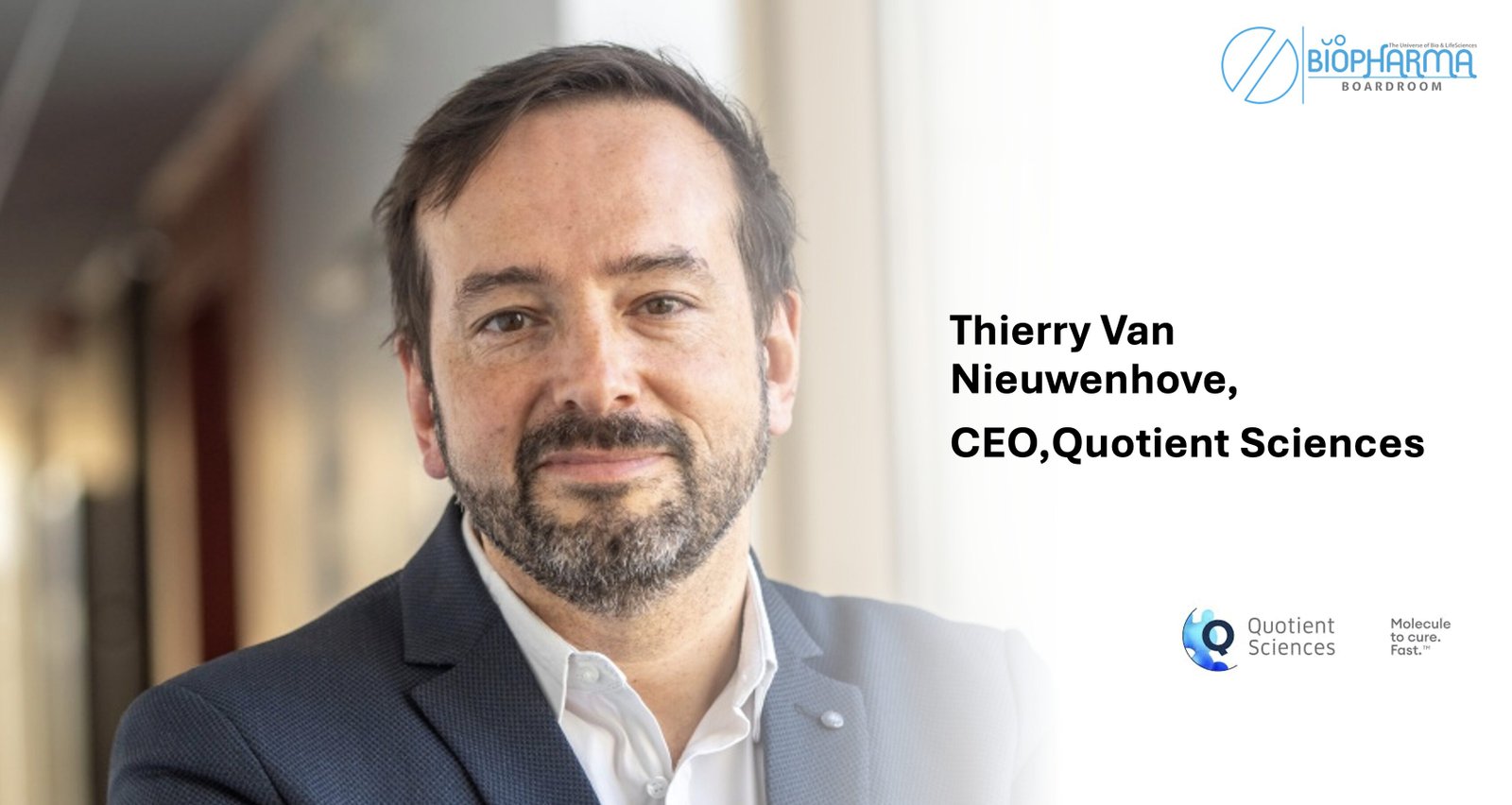
In this exclusive BioPharma Boardroom interaction, Thierry Van Nieuwenhove, CEO of Quotient Sciences, explores why nearly 90% of drug candidates fail and what the industry must do to change course. He highlights how integrated development models, such as Translational Pharmaceutics®, are reshaping the journey from molecule to medicine by uniting formulation, manufacturing, and clinical testing. From fostering cross-functional collaboration to leveraging AI-driven formulation and accelerating first-in-human studies, Van Nieuwenhove outlines how smarter, more connected approaches are enabling faster decision-making, reducing risk, and ultimately improving outcomes for patients.
Drug development continues to face high attrition rates. From your perspective, what are the key reasons nearly 90% of drugs fail, and how can more integrated development models help improve success rates?
High failure rates in development often stem from factors like poor candidate selection, difficult bioavailability and solubility considerations, and lack of consideration for CMC planning. Fragmented processes within and across stages (from discovery to development, development to clinical, and so on) further add to the time and cost. Integrated models, such as Quotient Sciences’ Translational Pharmaceutics®, bridge gaps by combining formulation, manufacturing, and clinical testing within a single platform. This approach enables more agile decision-making, reduces risks, and accelerates timelines, ultimately improving the likelihood of success for new therapies.
As the CEO of a global CRDMO, how do you bring together diverse specialist teams to ensure clients benefit from cumulative experience across thousands of molecules and programs?
We invest substantial effort in maintaining a very strong scientific team, recruiting and training the best talent from across the industry. Our scientific and drug development team supports multiple projects and lend expertise across various disciplines of our CRO and CDMO service offerings.
For every single project we onboard at Quotient Sciences, we gather a team of Drug Development specialists to contribute to the development strategy of the molecule. By bringing together professionals from CMC, Formulation, Clinical, and Medical disciplines, we provide comprehensive support to our customers throughout every stage of their programs. A lot of our customers have agreed that our team’s insight, and the way we work together, really set us apart from other service providers.
In what ways does an integrated end-to-end development approach accelerate timelines and improve decision-making for pharma and biotech companies?
I touched on the benefits of Translational Pharmaceutics® as far as combining formulation, manufacturing, and clinical testing within a single platform, but there are several factors in the way that Quotient Sciences do this that make the platform unique and successful.
We’ve often talked often about the benefits of accelerated first-in-human studies using Translational Pharmaceutics®. We successfully can help our customers achieve FIH milestones with phase-specific formulations to test safety and tolerability, with savings of 12 months on average compared to conventional methods to get to a FIH study.
Translational Pharmaceutics® is also a powerful solution to further optimize drug products. For one client, Ensysce Biosciences, we developed an extended-release drug product designed for overdose protection of a prescription drug. It was a complex program using a prodrug that requires activation by trypsin in the gastrointestinal tract and an inhibitor that requires delivery over an extended duration due to its short duration of action. We were able to help the customer adjust the release rate and dose for the immediate and extended-release beads across a two-part clinical study to support our client in meeting their goals.
How do you see AI and digital technologies transforming drug development, particularly in areas such as formulation, clinical trial design, and data-driven decision-making?
We are seeing great uses for AI to create value in formulation selection. Here, it can reduce experimental burden and shorten timelines, informed by human data, so molecules reach the clinic faster. Last November, we announced the integration of Intrepid Labs’ AI‑driven formulation platform into Quotient Sciences Translational Pharmaceutics® platform. Intrepid’s machine‑learning predictions with its ANDROMEDA™ platform can deliver measurable gains in speed to clinic, API savings, and confidence in development decisions. We are excited for the future as we expand our work with Intrepid Labs.
Your leadership approach emphasizes agility and a patient-first mindset—how do you embed these principles across a global organization while maintaining operational excellence?
This is where our approach to project management is critical. Strong project management improves drug program success by coordinating multidisciplinary teams, maintaining clear communication, managing risk, and keeping programs on track against aggressive timelines. We take great pride in this and that comes through in our consistently high ratings from customers in project surveys.
Looking ahead, what key shifts do you anticipate in the CRDMO landscape, and how should biopharma companies evolve their partnerships to remain competitive and innovative?
While using our Translational Pharmaceutics® platform is of course one option that biopharma companies can leverage to innovate their development pathway, overall, I do think the industry must better integrate Formulation/CMC with Clinical teams. As molecules become more complex, collaboration between this teams will be essential to address challenges such as bioavailability and permeation. Ensuring these groups work closely together to streamline development will ensure innovative treatments can reach patients as efficiently as possible.




© 2026 Biopharma Boardroom. All Rights Reserved.